Market stability reserve for ETS1
Under the EU emissions trading system (ETS) as it currently operates all allowances held in the reserve above a threshold of 400 million are cancelled. The Commission has proposed to end this invalidation mechanism, allowing the allowances to be kept as a buffer to support market stability.
To ensure the orderly functioning of the European carbon market and the MSR, increase long-term market predictability, and contribute to and align with the EU’s 2040 and 2050 climate targets, MEPs are proposing keeping the invalidation mechanism but raising its threshold from 1 February 2027 from 400 to 650 million allowances. This would maintain a sufficiently large buffer to absorb supply and demand imbalances, while avoiding the possible excessive build-up of allowances in the reserve that could occur under the Commission’s proposal.
Plenary backed the changes by 367 votes to 240, and with 59 abstentions. Parliament is now ready to start negotiations with Council on the final text.
Rapporteur Pierfrancesco Maran (S&D, IT) said: “Today’s vote strikes the right balance between climate ambition and industrial competitiveness. Raising the invalidation threshold and setting a clear date for entry into force gives the MSR the necessary flexibility while safeguarding the EU ETS. The agreement supported by a broad majority sets the scene for the ETS revision, proving that ambitious climate and industrial policies can go hand in hand."
(Description and Meaning)
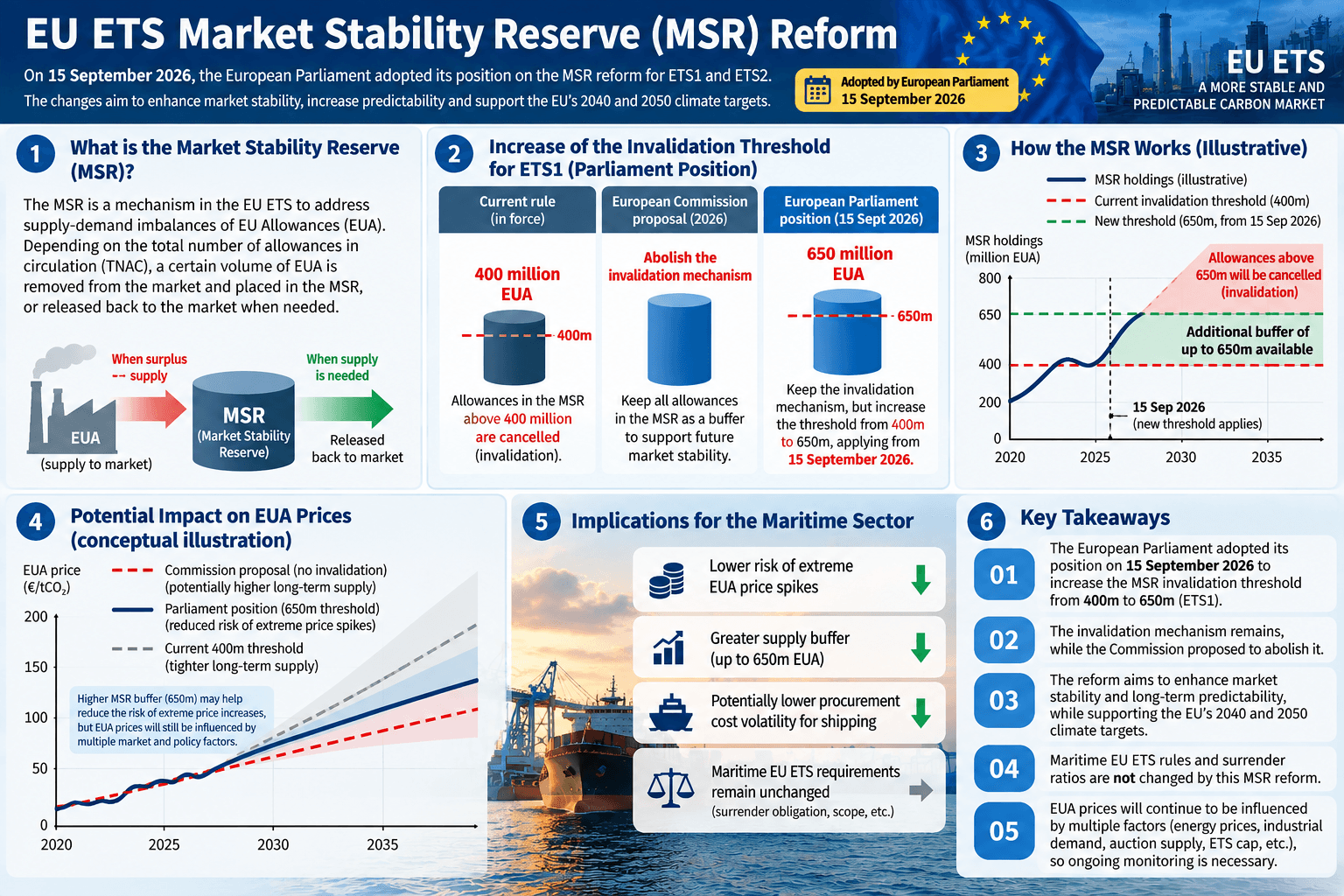
EU ETS Market Stability Reserve (MSR) Reform – What It Means On 15 September 2026, the European Parliament adopted its position on reforming the Market Stability Reserve (MSR) for ETS1. Under the current system, allowances held in the MSR above 400 million EUAs are invalidated, meaning they are permanently cancelled. The European Commission proposed abolishing this invalidation mechanism entirely, which would allow all allowances accumulated in the MSR to remain available as a buffer for future market stability.
The European Parliament has proposed a different approach: Keep the invalidation mechanism, but increase the threshold from 400 million to 650 million allowances from 1 February 2027.
What does this mean?
The proposed change would allow the MSR to retain a significantly larger reserve of EUAs before permanent cancellation takes place.
In simple terms:
Current system: MSR holdings above 400 million EUAs → excess allowances are cancelled.
Commission proposal: No invalidation threshold → allowances can continue accumulating in the MSR.
European Parliament position: MSR holdings up to 650 million EUAs can be retained → allowances above the threshold remain subject to invalidation.
This creates a larger market stability buffer while preventing an excessive accumulation of allowances in the reserve.
Potential impact on EUA prices
The reform should not be interpreted as the immediate release of an additional 250 million EUAs into the market.
Allowances held in the MSR are not automatically available for trading. Rather, the larger reserve provides greater flexibility to respond to future supply-demand imbalances.
Therefore, the proposal could help:
reduce the risk of extreme EUA supply shortages; mitigate excessive price volatility; improve long-term market predictability; and provide a larger supply buffer if the carbon market becomes excessively tight.
However, the MSR is not an EUA price cap. EUA prices will continue to be influenced by factors such as the ETS cap, auction volumes, TNAC, energy prices, industrial demand, power-sector demand and future EU climate-policy changes.
What does it mean for the maritime sector?
The proposal does not change the maritime EU ETS surrender obligations or coverage rules.
Shipping companies will still need to acquire and surrender the required EUAs for their ETS-covered emissions.
The main potential benefit for shipping is therefore indirect:
Larger MSR buffer → lower risk of extreme allowance scarcity → potentially lower risk of sudden EUA price spikes → improved predictability of carbon compliance costs.
Key takeaway
The reform is not designed to make EUAs cheaper. It is designed to make the EU carbon market more stable and predictable by increasing the MSR buffer from 400 million to 650 million allowances while retaining the invalidation mechanism.
The 15 September 2026 vote represents the European Parliament's negotiating position. The final legislation still requires negotiations with the Council. The Parliament's proposed date for the new 650 million EUA threshold is 1 February 2027.
← Back to News & Insights